

The Christmas season is full of activity and social events. Special church services. Work Christmas parties. School programs. Family gatherings. By the end of the season, we can be on social overload.
Then January often comes with a calendar filled with days of quiet solitude. Although we sigh with relief as January 2nd comes and hectic activity ceases, we can soon find ourselves battling depression as we experience a sudden drop in social interactions. During this season, we can perceive solitude as an enemy. But it does not have to be this way. Instead, solitude can be a friend we embrace with wisdom and grace.
The Benefits of Solitude
In The Powerful Purpose of Introverts, Holley Gerth says, “Solitude simply means choosing to be alone for a greater purpose.”[1] Practicing solitude can lead us to a deeper connection with God, ourselves, and others. Solitude “enables self-reflection, improves mental clarity, recharges our energy levels, reduces stress, takes the social pressure off, promotes independence, improves relationships, sparks creativity, and boosts productivity.”[2] Solitude is critically important to integrate into our lives, but we need to intentionally create healthy patterns when practicing solitude. Here are a few ideas for making the most of times of solitude.
Do Something Active
Researchers Thuy-vy Nguyen and Netta Weinstein have found that many people—especially young people—like to be actively doing something when in solitude.[3] As I reflect on this idea, I realize that a lot of my alone-time is active. I enjoy going to the gym and working out with my headphones on because it gives me an opportunity for solitude and reflection. Often when I have something worrying me or a problem to work through, I process those things in a positive way while working out. I also enjoy writing and shopping in solitude. These experiences give me the opportunity to think while moving about and accomplishing small tasks.
Practicing solitude does not require sitting quietly in a dark room. We can experience the benefits of solitude while cleaning our homes, cooking, exercising, shopping, or engaging in a hobby.
Journal
Journaling has been found to reduce symptoms of anxiety, depression, and PTSD.[4] Two forms of journaling that have been used as mental health interventions are expressive writing (writing deepest thoughts and feelings in twenty-minute sessions) and gratitude journaling (writing accounts of things we are grateful for).[5] When I journal, I write my thoughts as a prayer to the Lord. Consider getting a simple notebook or a beautiful journal to help intentionally process your thoughts and direct your thinking into positive thought patterns.
Drink Tea

I am not coming for your coffee, I promise. But in the last few years, I have learned that tea can serve us in many ways. A study by Huang et al. found that drinking tea improves divergent thinking, “the ability to offer unlimited solutions to a single problem.”[6] In this study, participants who drank tea before being given creative tasks performed better than those who drank water.
As a tea-drinker, I am fascinated by this empirical research. In the morning, I drink Darjeeling tea, which is a black, caffeinated tea. It is my go-to drink when I am doing my morning devotions or writing. But other teas can help us decompress. Raspberry leaf tea, cinnamon apple chamomile tea, and lavender and rose tea all help my body as well as my mind relax. When I feel anxious, certain non-caffeinated teas can comfort and even balance hormones. My favorite resource for understanding the benefits of tea is the owner of Tea Maze in Branson, Missouri.[7] (Yulin knows her teas!) Do some research to find what teas can help you, and try including them when practicing solitude.
Use a Guidebook to Create Healthy Rhythms
One resource that helped me learn how to intentionally use times of solitude was Holley Gerth’s Introvert by Design: A Guided Journal for Living with New Confidence in Who You’re Created to Be. As a life coach and former counselor, Holley offers several ideas and techniques that we can use when practicing solitude. This resource worked for me, but there may be other guidebooks or guided journals that will be a help to you. Do some research to find something that will help you structure your times of solitude to maximize its benefits.
Get into a Different Space
Sometimes we need to get away in our solitude. We can be in solitude in our homes, but the thoughts of laundry, dishes, and other responsibilities may make it hard to quiet our minds. Often, I need to get out of my typical environment to think clearly, which is why I work out in solitude at a gym or write at coffee shops.
Another option would be going on a solitude retreat, where you get away for two to three days. You can book a hotel or perhaps housesit for a friend who is going out of town. These simple breaks from the normal rhythms of life give us the opportunity to quiet our spirits so that we can hear from God.
Embracing Solitude
Do you embrace solitude as a comforting friend? Or do you view solitude as a thief who steals your joy? Like Jesus, we all need times to withdraw from people and embrace solitude (Mark 1:35, Luke 5:15, Luke 6:12). January is the perfect time to use solitude for a greater purpose. Let me know your favorite ways to practice solitude in the comments.
Copyright ©2026 by Carmen Dillon. All rights reserved.
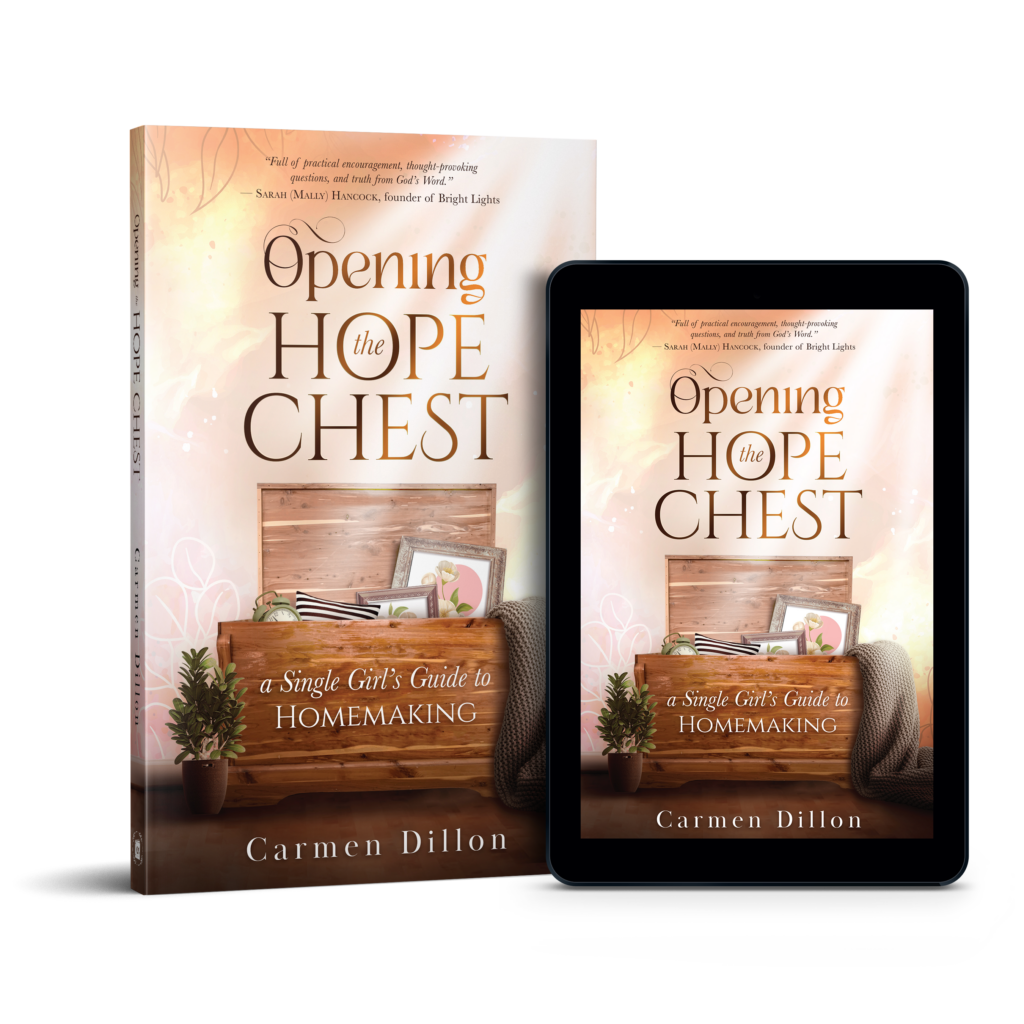
Want a book to read during January’s season of solitude? Check out my book Opening the Hope Chest: A Single Girl’s Guide to Homemaking for biblical encouragement and goals to reflect on for the new year.
Share:
[1]. Holley Gerth, The Powerful Purpose of Introverts: Why the World Needs You to Be You (Grand Rapids, MI: Revel, 2020), p. 54.
[2]. Sanjana Gupta, “How to Savor Your Solitude and Get More Comfortable with Being Alone,” VeryWell Mind, October 9, 2024, https://www.verywellmind.com/benefits-of-solitude-8722144.
[3]. Thuy-vy Nguyen and Netta Weinstein, “Speaking of Psychology: The Benefits of Solitude, with Thuy-vy Nguyen, PhD and Netta Weinstein, PhD,” interviewed by Kim Mills, Speaking of Psychology, no. 289, June 2024, https://www.apa.org/news/podcasts/speaking-of-psychology/solitude.
[4]. Monika Sohal, Pavneet Singh, Bhupinder Singh Dhillon, Harbir Singh Gill, “Efficacy of Journaling in the Management of Mental Illness: A Systematic Review and Meta-analysis,” Family Medicine and Community Health 10, no. 1 (March 18, 2022), 10.1136/fmch-2021-001154.
[5]. Sohal, et al., 10.1136/fmch-2021-001154.
[6]. Yan Huang, Year Choe, Soomin Lee, Enzhe Wang, Yuanzhi Wu, Lei Wang, “Drinking Tea Improves the Performance of Divergent Creativity,” Food Quality and Preference 66 (June 2018): 29–35, https://doi.org/10.1016/j.foodqual.2017.12.014.
[7]. Even though I now live in Cleveland, Ohio, I still order loose-leaf tea from Tea Maze in Branson, Missouri. You can check out the online store—there is a lot of description on the benefits of the various teas. But I also recommend giving the owner a call to get Yulin’s thoughts on teas.
Great post! Solitude is one of the prime spiritual disciplines and one of the best ways we can listen to God – even while active.
Thank you!