
This week, I had the opportunity to exhibit at the Michigan Association of Christian Schools’ educators’ convention. My new book Making Friendsgiving Meaningful and the drawing for a Friendsgiving Starter Kit drew some attention.

One woman asked, “Is Friendsgiving just for singles? My friends and I have been debating this.”
Smiling, I said, “Well, let’s think about the first Thanksgiving. Really, the first Thanksgiving looked like Friendsgiving.” As I explained, the woman’s eyes grew wide as she connected the dots. Then, she dashed off to talk to her friends.
Friendsgiving’s Growing Popularity
A 2023 study by Statistica Consumer Insights shows that 67% of Americans believe that spending time with family is central to the meaning of Thanksgiving.[1] Images of Thanksgiving depict families gathered around a long table. Grandparents, parents, children, aunts, uncles, and cousins converge under one roof. They pray over the food. Eat together. Take turns saying something they are thankful for. Then they play games, watch football, or simply talk and catch up on life.
Yet a growing number of people—mostly in the 14 to 44-year-old demographic—are beginning to celebrate Friendsgiving. Statistica’s survey found that 20% of respondents were going to spend Thanksgiving with friends.[2] Such gatherings are typically called Friendsgiving. Since no one wants to undercut the value of spending time with family, it seems we must use a name other than Thanksgiving to avoid infringing on our traditional view of the holiday.
Yet perhaps the first Thanksgiving was not as traditional as we think. Perhaps Friendsgiving best represents the first Thanksgiving.
The First Friendsgiving
Let’s think back to the first Thanksgiving. More than half of the Pilgrims had died the winter before. At that first Thanksgiving, how many were widowed? How many were orphaned? How many had lost at least one child? How many had left father and mother, aunts and uncles, siblings and cousins on the other side of the Atlantic Ocean?
Traditional family units did not gather in homes—the first Thanksgiving was a community celebration. Instead of each matriarch preparing a feast for her family, men and women worked together to hunt and prepare food. Even the Native Americans brought a side of deer.
No, the first Thanksgiving did not feature individual celebrations by traditional family units. It included people from all bloodlines and walks of life. People who had bonded through grief and necessity. Brothers and sisters in Christ gathered to celebrate and worship God. But the first Thanksgiving also involved a blending of cultures. After all, there were more Native American friends at the Thanksgiving feast than there were Pilgrims themselves.
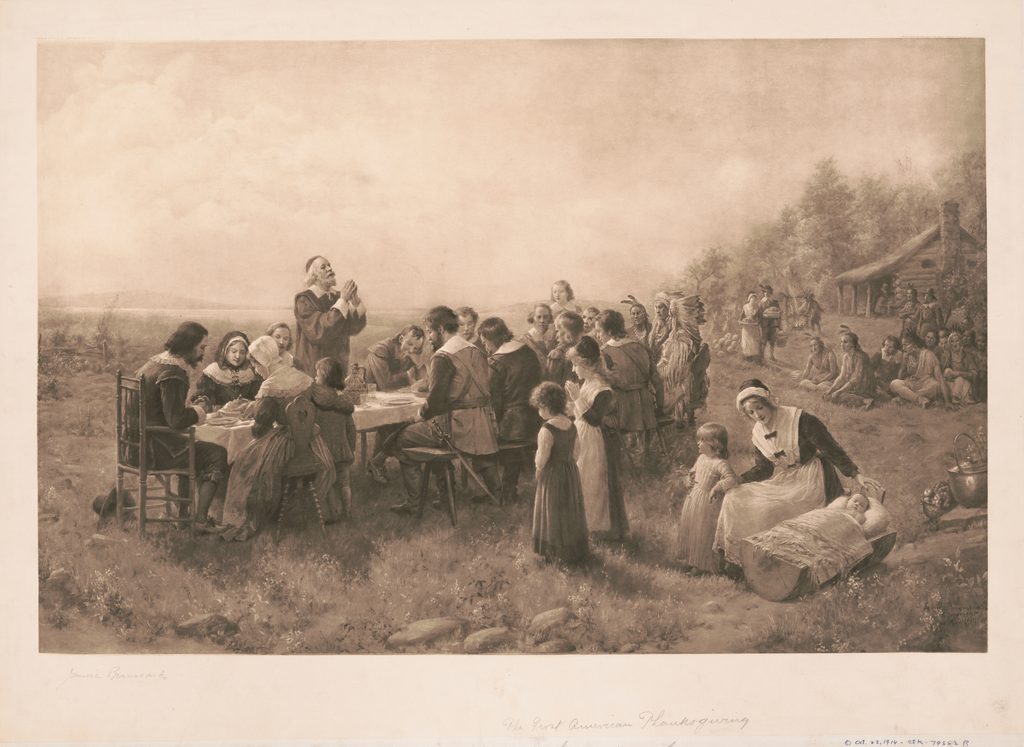
To the Pilgrims, the first Thanksgiving was not about the traditional family unit. Thanksgiving grew out of the Pilgrims’ desire to express their thankfulness to God as a community for His provision. A community came together to eat, fellowship, and worship—and they included every person from every background or culture who would come.
The Inclusivity of Thanksgiving
I love celebrating Thanksgiving with family. The opportunity for families to gather, eat, and express their thankfulness to God together is a wonderful tradition. But we do not need to shy away from expanding our view of the celebration. Thanksgiving is not just for married people. Friendsgiving is not only for singles. Thanksgiving (or Friendsgiving) is about people of all ages and stages coming together in community to worship God.
This Thanksgiving, something may have shifted in how you celebrate or whom you celebrate with. Perhaps you are missing a loved one. Perhaps you cannot be with family members for one reason or another. Perhaps you feel awkward about being single and not bringing your own traditional family unit to the table. Yet we can remember that the first Thanksgiving was never about having certain people gathered at a table. It was about worshipping God in community.
God’s Definition of Family
Although God created and values the traditional family unit, He also gave an extended definition of family in the New Testament.
Remember Jesus’s definition of family? He said,
“Whosoever shall do the will of my Father which is in heaven, the same is my brother, and sister, and mother” (Matthew 12:28, 50 {KJV}).
Jesus welcomes all people into His family—His community. As we look forward to Thanksgiving, let’s embrace the opportunity to worship God for His goodness. And let’s do it with someone, somewhere—whether that is at a table with family, on the couch with a friend, or behind a counter at a soup kitchen.
[1]. Katharina Buchholz, “Thanksgiving, Friendsgiving, or Home Alone,”
Statistica, November 23, 2023, https://www.statista.com/chart/28817/thanksgiving-plans-gcs/.
[2]. Buchholz, “Thanksgiving, Friendsgiving, or Home Alone.”
Copyright © 2026 by Carmen Dillon. All rights reserved.
Share:
New Book Available!
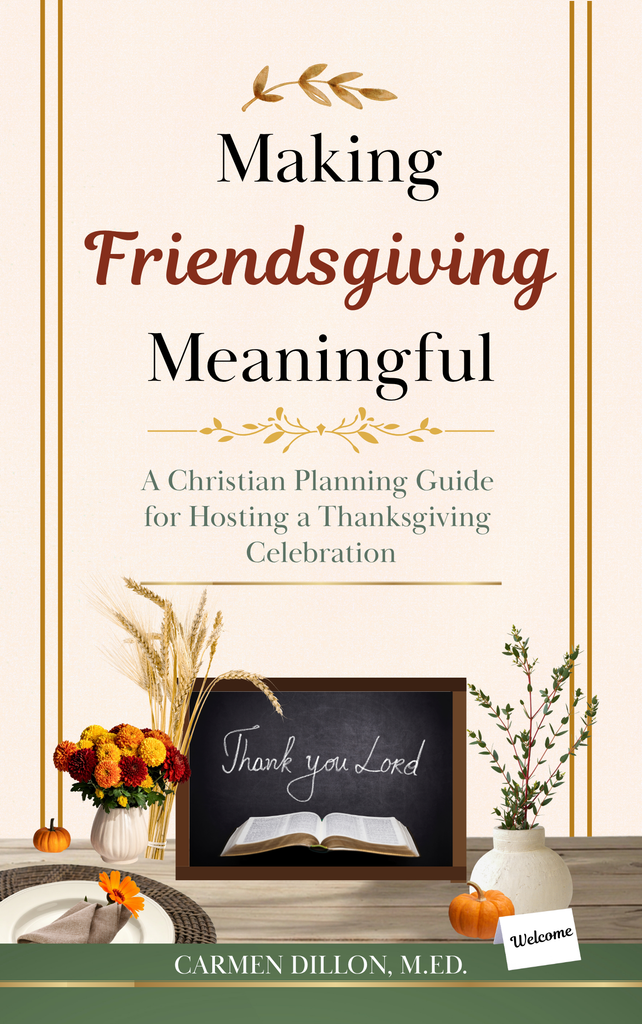
Making Friendsgiving Meaningful provides ideas for hosting a meaningful Friendsgiving celebration. Learn how to foster fun and fellowship, prompt meaningful reflections, plan your schedule, and design a beautiful celebration while keeping the cost and stress manageable.
The ideas in this guide can be adapted for traditional family gatherings. Free downloadable resources are included.
Available on Amazon: https://www.amazon.com/dp/B0HGWH96KD
Great thoughts! I appreciated this. Also, you were at my home church of Calvary – Midland. Cool things!
Thank you! Wow! I did not realize Calvary was your home church! It was a blessing to be there. It was long drive for us in Cleveland–4 hours. 🙂 But we were blessed by the preaching and sessions.
Great post! One of my favorite Thanksgivings was the year my Asian students joined us for the big meal. It was a time to explain what Thanksgiving means and a fun way to make new friends over a meal. Friendsgiving is a wonderful way to invite inclusivity into our lives. Hope you have another great one this year!
That’s great! The Thanksgiving season gives us great opportunities for outreach.